
After leaving Germany, we briefly ventured to three Austrian cities: Innsbruck, Graz, and Vienna via the ever reliable train system.
Innsbruck is situated along the Alps and used this advantage to host both the ’64 and ’76 winter Olympics. The ski jump built for the occasion, Bergisel, is now used as a tourist attraction (trap) where if you’re too lazy to hike up the mountain, you can pay to visit the tower and peer out over the city. It is a pretty crazy looking contraption. Even though I used to be pretty good at the ski jump on the Winter Olympics game on a commodore computer like 15 years ago, I can’t imagine how you begin training in real life to voluntarily jump off that thing on skis. Matt and I are too poor to take the easy route, so we did a short hike up on our own, but still got a panoramic view above the impressive city of a mere 110,000 people.
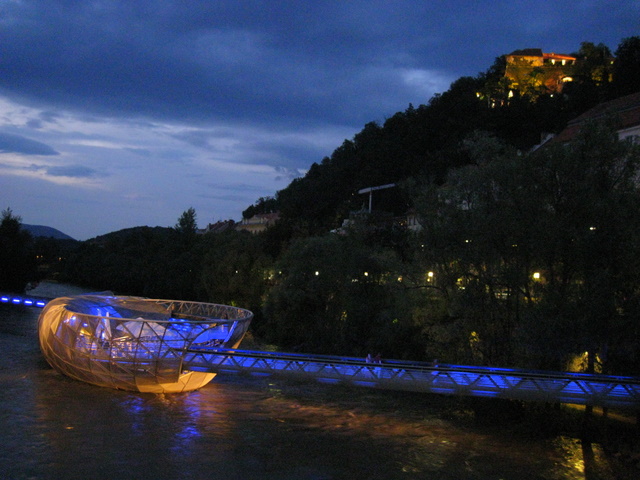 Graz has a unique sense of architecture. A renowned architectural “gem” of the city, known to locals as ‘the friendly alien’, reminds me more of a giant cow udder. Lonely Planet compares it to a “mutant bladder”. Another structure, an artificial island in the River Mur in the center of the city holds an amphitheater and café, and is shaped like a giant seashell… There is little in the city to denote Arnold Schwarzenegger’s origins.
The next stop of Vienna provided a much more classic dose of architecture, even though a lot of palaces, museums, etc. are starting to look very similar. There are only so many buildings of comparable styles that I can see in a short time span and still be amused. The same goes for art and natural history museums. They did have this pretty cool program set up though, similar to Ann Arbor’s Top of the Park, which they play movies on a giant screen in front of their (beautiful) parliament building and numerous restaurants set up temporary tents and peddle their food. Unfortunately, for yours truly, not being culturally sophisticated enough to appreciate classical music movies about Mozart, etc. I wasn’t really keen on the schedule.

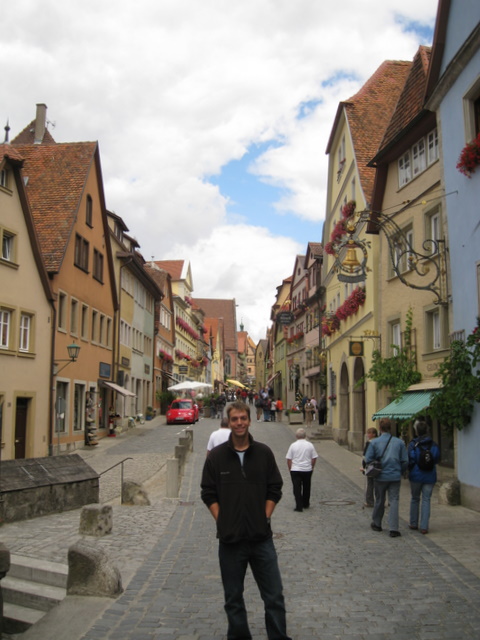
 From what I remebered in German class, East Germany (in 1998) was still living in the ’60s, kind of like Cuba, and many of the buildings had not been repaired since WWII. Fortunately for Dresden, this was not true. It has been rebuilt and to us, looked no different to any of the Western German cities that would follow. When we were in New Zealand, we met some Germans who mentioned that most young people were fleeing East Germany to West Germany for a higher paying job and a higher standard of living. As unfortante as this is, from what we could tell, East Germany seems to be headed in the right direction. Germany is at the forefront of not only supplying loads of cash to East Germany, but also to the weaker countries of the European Union.
 In Hamburg, we went to Ballinstadt. In the mid 1800s to the early 1900s, Hamburg was the world’s leading exporter of Homo sapiens (not only Germans, but mostly Polish under Russian oppression). Ballinstadt (actually the person running the place) was where these people would go before headed to the New World. Ballinstadt now is a museum that showed how people lived as they waited to go to the New World, explained the types of people, their origins, and what it took to leave Europe to the New World. As a side bonus, you could use the ancestry.com resources for free while you were there.




 I Quit My Job To Travel