 We ended up waiting at the Amman airport for about an hour and a half in order to take the public bus, to our executive suite at the Le Meridian – how about that for an oxymoron? You can imagine how utterly ridiculous we look walking in, where formal wedding receptions are taking place, with our backpacks… Once again, Matt’s days as a consultant proved beneficial when we were able to not only stay at a nice hotel, but get upgraded to an executive suite with all the benefits that the room affords. One of the privileges included access to the Royal Club Lounge, which again we looked very out of place among the executives in business suits in our raggy t-shirts and shorts.
I can describe the process to get into the hotel now because I’m back home and won’t have to go through the process of allaying my mom’s fears. Because of the terrorist bombings at hotels that took place almost three years ago, to get into our hotel we had to go through metal detectors and have our bags x-rayed. Not to mention the unnerving sight of the well armed (automatic rifles strapped across their chests) guards in military fatigues pacing around the hotel perimeter.
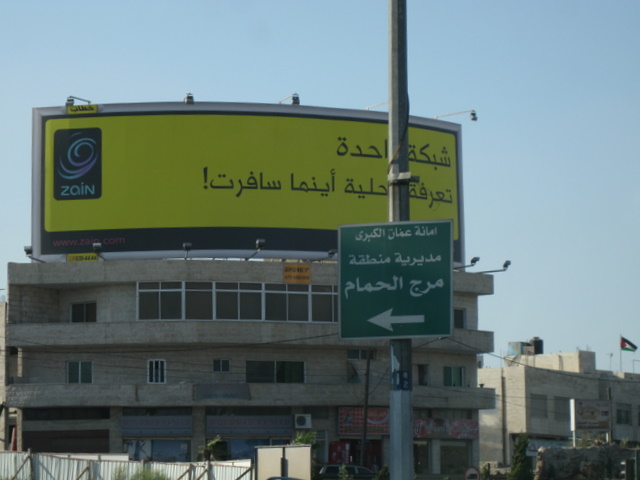 Unfortunately, staying in a nice hotel doesn’t come without drawbacks. Apparently the average guest doesn’t take public buses to tourist sites, so the concierge desk is pretty useless when it comes to budget options. Deciding not to get charged twice as much as it should actually cost to hire a driver for a day through the hotel, we decided to rent a car to drive toPetra – three hours from the city of Amman. I did do some research into self driving, and everything I read said that it was pretty easy to get around; well maintained roads and the locals pretty much adhere to driving laws, so it seemed like the best option to get around for a reasonable price. With all the accounts I read of driving through Jordan, not one of them managed to mention the important fact that a lot of the road signs are only in Arabic…
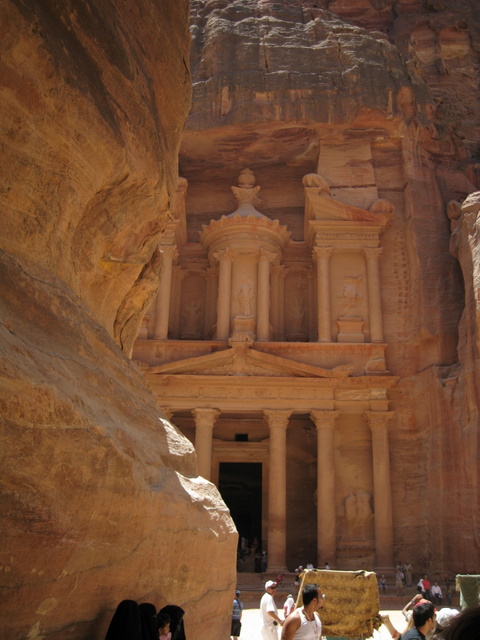 After a few “minor” wrong turns we arrived at Petra, one of the new Seven Wonders of the World. It is basically an archeological site of rose-colored stone and was used in ‘Indiana Jones and the Last Crusade’. From the entrance to the furthest point is about five miles, and allegedly only about five percent of the site has been excavated so far – basically it’s huge. We wandered around on foot to the major sites, despite the locals numerous attempts to get us to hire a “taxi” (donkey or camel).
Matt boycotted shaving in an effort to look “more middle-eastern”, complete with his blonde hair and blue eyes… It was a good thing it didn’t actually work though, because on the highway leading to the Dead Sea, we got stopped by one of the military checkpoints and didn’t have our passports. Luckily a Michigan driver’s license and the fact that we were obviously tourists allowed us to pass through without the guards’ use of the automatic rifle’s strategically placed barrel right by the car window. The highway also had people riding camels on the road shoulders…
Getting through the checkpoints and the brief associated scare, we arrived at the Dead Sea. The water has a salinity of about 30%, which is about 8.5 times saltier than typical oceans. Because of the high salt content, no plant or animal life can sustain life – hence the name. It is quite a weird sensation to float in the water; it is impossible to sink, though very difficult to move around. Trying to “stand up” in deep water, you still pop up so your shoulders are above the surface, then your legs gravitate to the surface as well until you are laying down comfortably as if on a raft. The water doesn’t even really feel like water; it’s closer to a gelatin type texture. 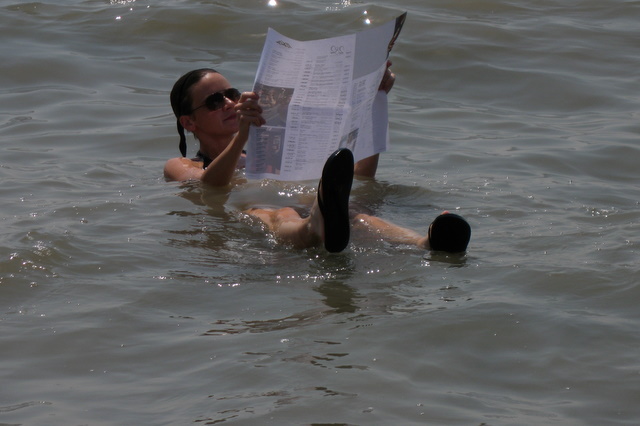
All in all the Middle East was unlike anything I have ever witnessed before. I knew that women weren’t necessarily seen as being equal to men; however I had no idea to what extent it was still practiced by the general population. A good example was when Matt and I were in the taxi going to the airport: the driver asked what airline we were flying. I replied ‘Royal Jordanian’. The driver again asked what airline and added the preface ‘sir’. Apparently, my word wasn’t good enough for him… I also have never been anywhere that I didn’t dress conservatively enough in my regular clothes. Being among the veiled Muslim women, I felt that wearing capris might have been showing a “little too much skin”, but it was simply too hot for jeans.


 From what I remebered in German class, East Germany (in 1998) was still living in the ’60s, kind of like Cuba, and many of the buildings had not been repaired since WWII. Fortunately for Dresden, this was not true. It has been rebuilt and to us, looked no different to any of the Western German cities that would follow. When we were in New Zealand, we met some Germans who mentioned that most young people were fleeing East Germany to West Germany for a higher paying job and a higher standard of living. As unfortante as this is, from what we could tell, East Germany seems to be headed in the right direction. Germany is at the forefront of not only supplying loads of cash to East Germany, but also to the weaker countries of the European Union.
 In Hamburg, we went to Ballinstadt. In the mid 1800s to the early 1900s, Hamburg was the world’s leading exporter of Homo sapiens (not only Germans, but mostly Polish under Russian oppression). Ballinstadt (actually the person running the place) was where these people would go before headed to the New World. Ballinstadt now is a museum that showed how people lived as they waited to go to the New World, explained the types of people, their origins, and what it took to leave Europe to the New World. As a side bonus, you could use the ancestry.com resources for free while you were there.
 I Quit My Job To Travel